
Brisbane buyer’s guide · updated 16 October 2026
How to choose an electric bike in Brisbane
The best e-bike is not the one with the biggest number on the box. It is the one that fits you, handles your real hills and distance, can be serviced locally and is legal to ride. Use this guide to narrow the choice before a test ride.
- Choose for your route
- Compare watt-hours
- Test fit and braking
- Check legal labelling
Start with the job
Three common Brisbane riders, three sensible starting points
NCM Prague
A straightforward hardtail for commuting, delivery work and everyday paths when purchase price matters most. It starts at $1,299 and uses a 36V 13Ah battery.
NCM T3s
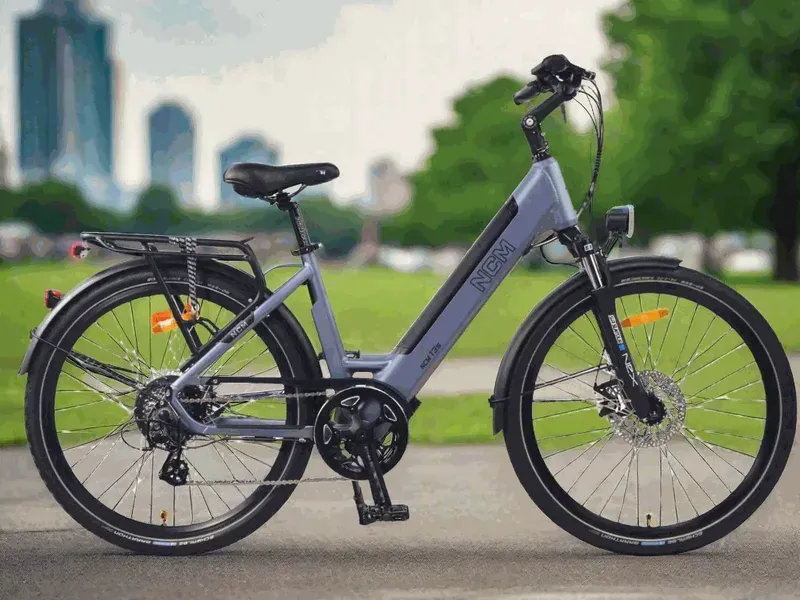
A step-through city bike for easier mounting, frequent stops and a more upright everyday ride. Its 48V 12Ah battery is rated at 576Wh.
NCM Moscow M3
A hardtail with hydraulic disc brakes for riders who expect steeper climbs, faster descents or rougher routes. Its battery is also rated at 576Wh.
Rent before you buy
Real riding exposes what a showroom cannot. Eligible customers can receive 50% of rent as purchase credit, capped at $250, when buying within the offer window.
Prices and claimed maximum ranges were checked on 16 October 2026. Stock and offers can change; confirm the current listing before paying.
Fit before features
A bike that feels safe at zero speed is usually the better bike
Most buying mistakes happen before the motor matters. At a stop, you should feel in control. When walking the bike, you should be able to steer it around a doorway, park it and manage its weight without a struggle.
- Frame: choose step-through when easy mounting and frequent stops matter; choose step-over when you prefer that fit and riding position.
- Contact points: check saddle height, reach to the handlebar and wrist position.
- Wheel choice: larger wheels can roll smoothly; the right size still depends on frame fit and confidence.
- Carrying: confirm the bike, battery and rack work with stairs, lifts, transport or storage at home.
- Payload: include rider, lock, bags and cargo—not only body weight.
Battery and range
Compare energy, then plan for your worst normal day
Battery energy is measured in watt-hours (Wh): voltage multiplied by amp-hours. A 48V 12Ah battery is about 576Wh; a 36V 13Ah battery is about 468Wh. Watt-hours make different batteries easier to compare, but they do not promise an exact distance.
- Measure the longest normal return trip. Include the ride home, not only the outbound leg.
- Add a reserve. Hills, heavy cargo, high assistance, headwinds, stop-start traffic, tyre pressure, heat and battery age all change range.
- Check charging reality. Know where the bike can be charged safely and whether the battery must be removed.
- Ask about replacement support. A compatible battery, charger and connector matter years after the sale.
Safe charging basics: use the correct manufacturer-supplied charger, charge on a hard non-combustible surface, keep exits clear, do not charge a damaged or swollen battery, and do not leave it charging unattended or while asleep. Read the ACCC lithium-ion battery guide and Queensland Fire Department advice.
Brisbane terrain
Match the motor system and brakes to the route you actually ride
River paths and commuting
Comfort, predictable assistance, lights, a practical lock and rack compatibility often matter more than maximum off-road capability.
Steep neighbourhoods
Test the bike on a genuine climb. Rider weight, gearing, battery state and how the controller delivers assistance matter alongside motor rating.
Delivery work
Prioritise fit for long hours, real usable range, reliable brakes, puncture planning, cargo setup and fast local repair support.
Rail trails and rougher surfaces
Look at tyre volume, braking control, riding position, battery reserve and whether the bike remains comfortable after several hours.
Queensland legal check
Do not buy an illegal device disguised as an e-bike
For use in Queensland public places, check the fitted bike—not only an advertisement or selectable software mode. A compliant e-bike has pedals as its primary power source, no more than 250W maximum continuous rated motor power, motor assistance that stops at 25km/h and throttle-only assistance limited to 6km/h. Newer bikes need the required EN 15194 labelling; eligible older or special-purpose bikes may use the official assurance-scheme pathway.
- Photograph the compliance label and keep the invoice.
- Ask for the continuous motor rating, not only a peak-power claim.
- Do not assume a 500W or 750W motor becomes legal through a software lock.
- From 1 July 2026, sellers cannot sell an e-mobility device to a buyer under 16.
- Riding rules are separate from buying rules; check licence, age, helmet and path-speed requirements.
The test ride
Use ten minutes to test what specifications cannot tell you
- Start and stop repeatedly. Check balance, step-over clearance and whether both feet feel confident at a stop.
- Try low-speed control. Turn tightly, ride slowly and feel whether assistance arrives smoothly rather than surging.
- Climb and restart on a hill. Test the route condition that matters most in Brisbane.
- Brake progressively. Check lever reach, stopping confidence and control—not just brake names on a spec sheet.
- Ride with your normal load. Bring the bag, cargo or child-seat questions that affect daily use.
- Walk and park it. Feel the real weight and check the kickstand, rack and storage fit.
Whole-life value
The cheapest sticker price can become the expensive option
Local service
Ask who diagnoses electrical faults, completes routine servicing and handles warranty work after the sale.
Parts path
Check future access to batteries, chargers, displays, brake parts, tyres and model-specific components.
Security budget
Allow for a serious lock and secure storage. The right lock is part of the bike purchase, not an afterthought.
Downtime
For a commuter or delivery rider, repair turnaround and replacement-part access can matter more than a small saving at checkout.
Straight answers
Electric bike buying FAQs
What type of e-bike is best for Brisbane?
Choose for your route. A comfortable step-through suits frequent stops and city paths; a hardtail with hydraulic brakes suits steeper or rougher routes; a simpler commuter hardtail can be the best-value everyday choice. Fit and a real test ride matter more than category labels.
How much battery range do I need?
Start with your longest normal return trip and add a reserve for hills, wind, weight, high assistance and battery ageing. Compare watt-hours, but treat every advertised maximum range as an estimate rather than a promise.
Should I buy online without a test ride?
A test ride is strongly recommended, especially for a first e-bike. It reveals fit, motor smoothness, brake feel and low-speed confidence. If you cannot test first, confirm sizing, return terms, local service and exact specifications before paying.
Can someone under 16 buy an e-bike?
No. From 1 July 2026 it is illegal to sell an e-mobility device to a buyer under 16 in Queensland. We require online confirmation and check the buyer’s photo ID at collection.
Is a high-powered e-bike legal if it has a 25km/h setting?
Not merely because of a software setting. Queensland guidance says a motor above 250W maximum continuous rated power is not made compliant by a software lock. Check the fitted motor and required compliance label.
Should I rent or buy?
Buying usually makes more sense for long-term frequent use if you can manage maintenance, storage and upfront cost. Renting can suit a short stay or trial period and includes support. Use our rent-versus-buy calculator and explanation.
Sources: Queensland Government e-bike rules, Queensland selling rules, EPAC Assurance Scheme, ACCC battery guide and Queensland Fire Department battery safety. General information only; check official sources for updates.